Nyhed
Massive boost to AI research and talent development at AAU
Lagt online: 12.02.2026
Nyhed
Massive boost to AI research and talent development at AAU
Lagt online: 12.02.2026
Massive boost to AI research and talent development at AAU
Nyhed
Lagt online: 12.02.2026
Nyhed
Lagt online: 12.02.2026
By Susanne Clement Justesen, AAU Communication and Public Affairs
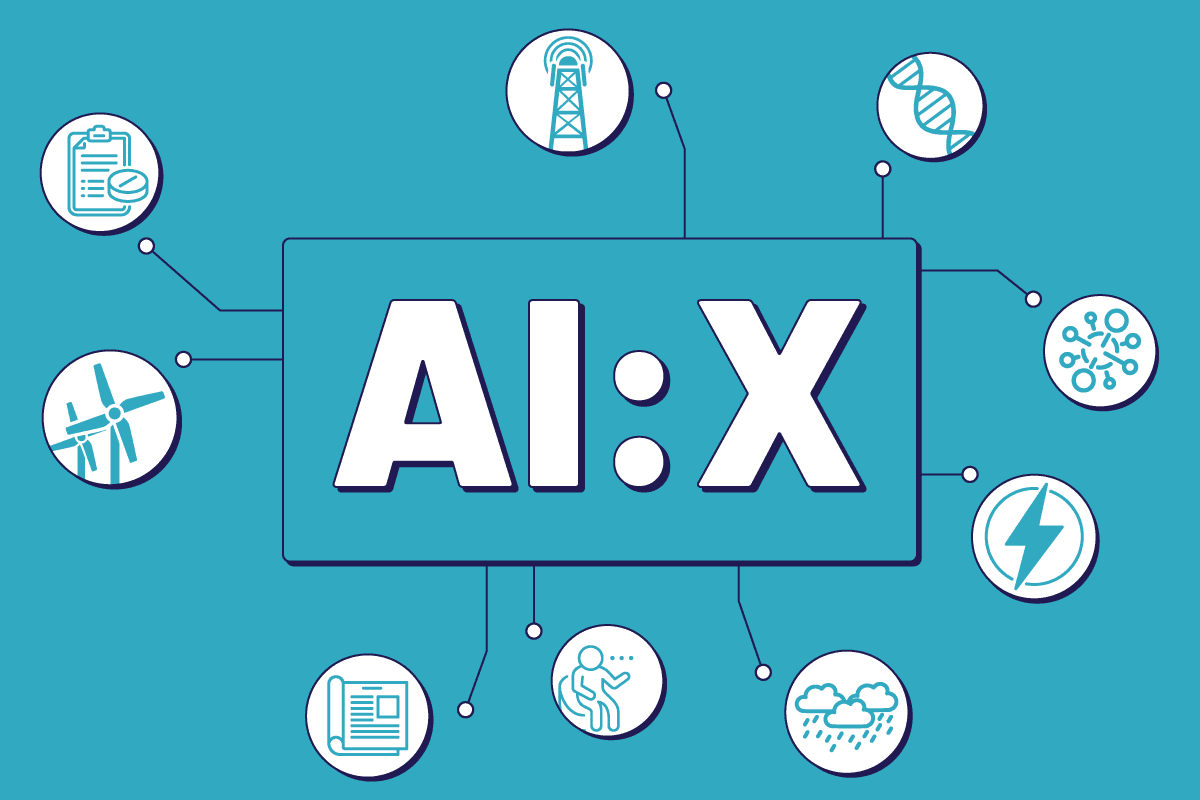
Graphic: Alberte Spork, AAU Communication and Public Affairs
Translated by LeeAnn Iovanni, AAU Communication and Public Affairs
AAU aims to be a key player in AI solutions with high societal impact. Thus, on behalf of the Executive Management, the deans approved nine AI:X Labs that will generate research breakthroughs, strengthen new AI talent development and expand AAU's position as a leading AI research institution.
The new labs are:
Read more here
According to Thomas Bak, Dean of the Technical Faculty of IT and Design, on behalf of the Executive Management, the deans weighted originality, academic strength, interdisciplinarity, feasibility and expected results in designating the new AI:X Labs.
"The nine labs address important knowledge gaps, and the AI solutions thus have the potential for significant societal impact. The labs will enable strong research collaborations that we expect will strengthen the university's research profile," says Thomas Bak, the executive manager coordinating the AI:X Labs initiative.
Associate professors Mette Simonsen Abildgaard and Chen Li are co-directors of AI:INFRA, where they will develop AI solutions that take into account the needs, desires and infrastructure frameworks that exist in Greenland.
"As a humanistic infrastructure researcher in the Arctic, my motivation for being co-director of AI:INFRA is a desire not only to understand and interpret infrastructural development, but also to actively shape it. This is best done in interdisciplinary research collaborations and in dialogue with the people who have to live with the infrastructure," says Mette Simonsen Abildgaard.
She envisions that in four to five years, AI:INFRA will have developed solid models for collaboration between researchers and local communities on the development and implementation of AI. The research group will also have explored, developed and tested site-specific AI solutions.
For Hongo Zhao, Associate Professor in AAU Energy, who is co-director of AI:HARDWARE along with Edlira Dushku, Assistant Professor, the development of hardware entails many manual processes and long calculations, making it difficult to work quickly and efficiently.
"Today, we hardly use AI in our work on hardware. With AI:HARDWARE, I envision AI-based tools becoming a natural part of our day-to-day life. They can act as sort of 'design copilots' that help researchers and engineers quickly create an overview, identify improvements and work their way to the best solutions. This can make the hardware components both more reliable and more energy-efficient. At the same time, AI can open up completely new avenues for developing hardware," says Hongo Zhao.
One of the biggest challenges in developing AI systems in the healthcare sector is access to clinically relevant data. A significant part of this data is available in unstructured form as medical records. To make data more usable while also maintaining trust, it is necessary to combine expertise in data science and clinical data science. Co-directors Charles Vesteghem and Daniele Dell'Aglio will investigate this in AI:HealthData Lab.
"We aim to develop AI methods that can structure data that is clinically relevant and trustworthy by utilizing both structured and unstructured data. This will enable the development and implementation of AI solutions in clinical practice. To demonstrate the potential, we focus on generating contextual patient record summaries for general practitioners," says Charles Vesteghem, Associate Professor, Department of Clinical Medicine.
The research team expects that an intelligent, situation-dependent mapping of the most important things in the patient's medical records – so that a doctor quickly gets the necessary overview – will be knowledge that other researchers and private actors can build on.
According to Karina Dahl Steffensen, Dean, Faculty of Medicine it will be extremely inspiring to follow the development work in the various labs.
"AI:X‑Labs is a unique opportunity to ensure interdisciplinary collaboration at a high academic level. As Dean of the Faculty of Medicine, it is inspiring to see so many good interdisciplinary research ideas outlined in the applications. It will be incredibly interesting to follow the development of the collaboration interfaces we have with the other faculties through the three AI:X Labs that the Faculty of Medicine is part of with the Faculty of Engineering and Science, the Faculty of Social Sciences and Humanities, and the Technical Faculty of IT and Design, respectively," says Karina Dahl Steffensen.
Each research team is led by two co-directors and employs two PhD students. The mentors are AAU professors. A key part of the AI initiative is the hiring of 18 new PhD students in August 2026.
According to Thomas Bak, AAU is investing in the next generation of talented AI researchers and teachers with AI:X Labs.
Facts
AAU's AI:X Labs is a framework for interdisciplinary AI collaboration where "X" indicates the intersection between different disciplines. The different labs bring together researchers from two disciplines on complex challenges with AI as a common tool.
The Faculty of Social Sciences and Humanities and the Faculty of Engineering and Science are each investing in four PhD students; the Faculty of Medicine is investing in three and the Technical Faculty of IT and Design in seven PhD students. With these 18 PhD students plus the 20 who are already employed, AAU will have a total of 38 PhD students affiliated with the initiative in August 2026.
See previous coverage of AAU's ambitious AI initiative here